Understanding Teental: The Foundation of Tabla Rhythm
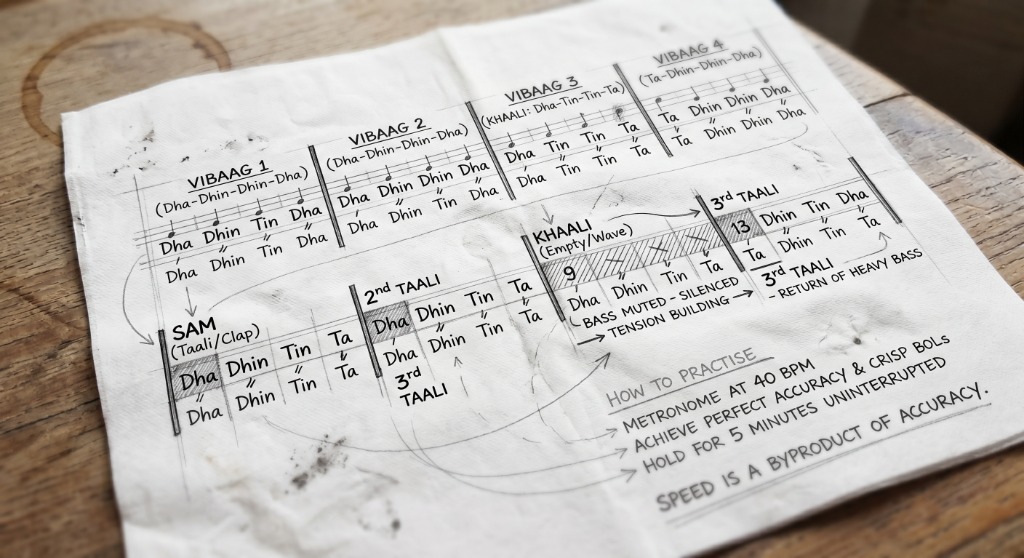
Teental is a 16-beat cycle and forms the absolute foundation of North Indian classical rhythm. If you can master Teental at slow, medium, and fast temples (Vilambit, Madhya, and Drut Laya), you essentially possess the keys to playing any other rhythm in the entire musical canon.
The Structure and Vibaag
Teental is heavily symmetrical. It is divided into 4 sections (Vibaags) of 4 beats each (4+4+4+4). The first beat is called "Sam", the most heavily emphasized beat. The 5th beat is the second "Taali" (clap), the 9th beat is the "Khaali" (empty/wave), and the 13th beat is the third "Taali".
Understanding the Khaali is critical. This is the section where the deep bass of the Bayan is intentionally silenced or muted to create an acoustic runway that builds tension, leading back up into the heavy bass of the powerful 13th and ultimately 1st beat (Sam).
The Theka
The standard theka (groove) is: Dha Dhin Dhin Dha | Dha Dhin Dhin Dha | Dha Tin Tin Ta | Ta Dhin Dhin Dha.
Notice how the 3rd section (the Khaali) swaps "Dhin" for "Tin". This signifies the lifting of the bass.
How To Practise Teental
Practise using a metronome or electronic Lehara app. Set it to a painfully slow 40 BPM. Make every single syllable crisp, balanced in volume, and precisely on the beat. Only when you can play it perfectly for 5 uninterrupted minutes should you increase the speed to 45 BPM. Speed is a byproduct of accuracy.